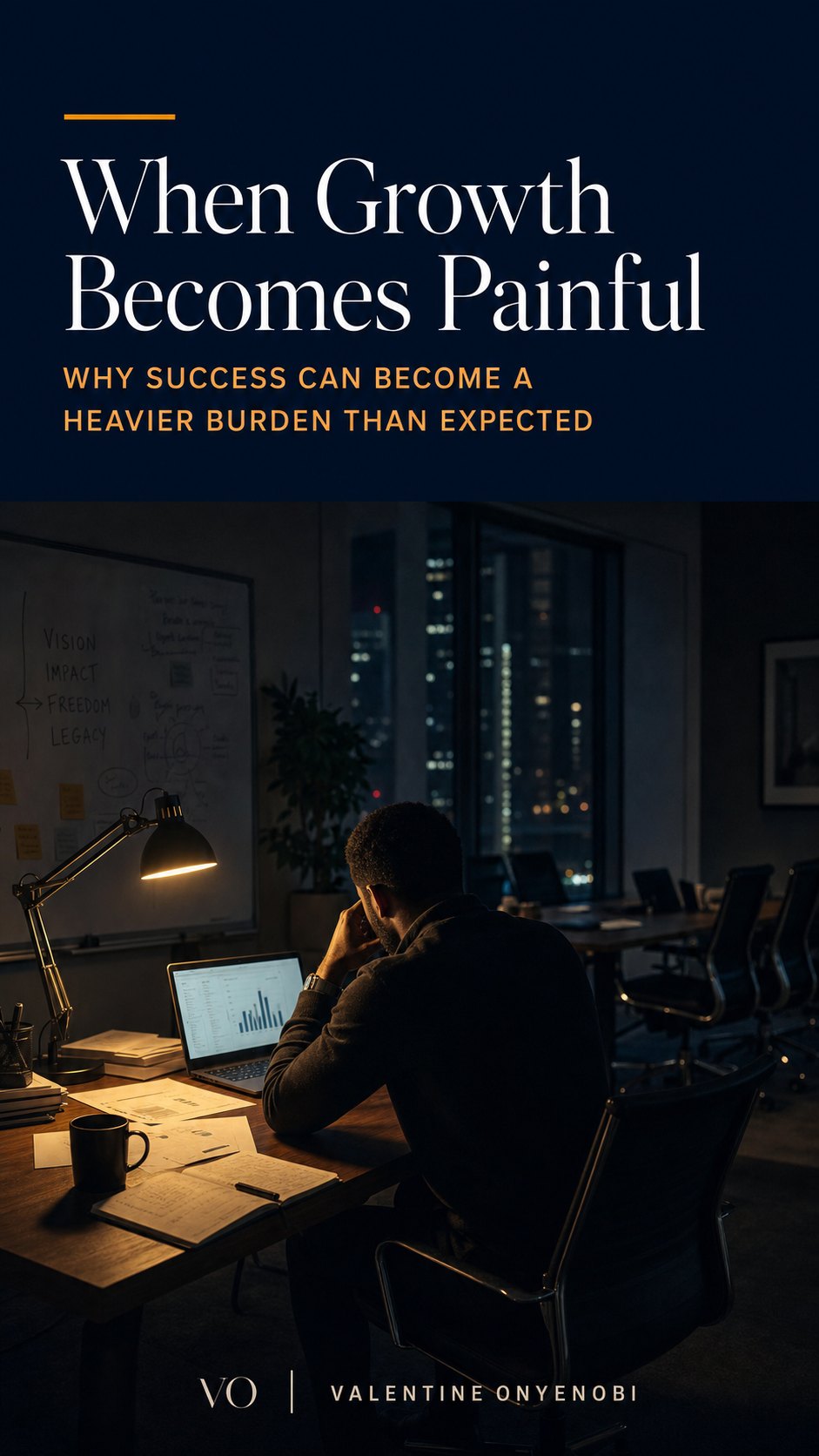
When Growth Becomes Painful
Why success can become a heavier burden than expected.

Published 13 October 2026 · 3 min read
Most founders imagine success arriving as relief.
The difficult period comes first.
- Long days.
- Limited resources.
- Constant uncertainty.
Then the business begins to work.
- Customers return.
- Revenue improves.
- The team grows.
- Opportunities appear.
The pressure starts to ease.
At least that is the expectation.
Yet a surprising number of business owners experience something very different.
The business grows.
The demand grows with it.
A founder who once worried about finding customers now worries about managing people.
A business that once struggled to generate sales now struggles to fulfil demand.
Problems that seemed temporary become permanent responsibilities.
Success arrives carrying more weight than expected.
This is not unusual.
It is common enough that many entrepreneurs quietly accept it as part of the journey.
Business becomes larger.
Life becomes harder.
What makes this interesting is that the pressure rarely comes from where people expect.
It is easy to assume that growth itself is the problem.
- More customers create more work.
- More employees create more complexity.
- More locations create more moving parts.
All of that is true.
But two businesses can grow at the same rate and have completely different experiences of growth.
One becomes more resilient.
The other becomes more dependent.
One creates freedom.
The other creates obligation.
One allows the founder to focus on bigger decisions.
The other demands the founder's attention every hour of every day.
The difference is rarely visible from the outside.
From the outside, both businesses appear successful.
Inside, they are becoming very different organisations.
One of the earliest signs is surprisingly easy to miss.
The founder becomes the solution to everything.
A customer issue needs resolving.
The founder gets involved.
A supplier problem emerges.
The founder gets involved.
A staff disagreement appears.
The founder gets involved.
At first, this feels responsible.
Nobody cares more than the person who built the business.
Nobody understands the business better.
Nobody sees the full picture.
The business benefits from their involvement.
Until it doesn't.
Growth has a way of changing the economics of attention.
The same level of involvement that helped build the business often becomes the thing that constrains it.
The same habits that created progress can quietly become obstacles to it.
- More customers create more decisions.
- More staff create more questions.
- More opportunities create more demands.
Eventually the business reaches a point where every answer cannot come from the same person.
Not because that person lacks ability.
Because there are not enough hours in the day.
This is where something subtle begins to happen.
The founder works harder.
The organisation becomes slower.
The founder becomes busier.
The organisation becomes more dependent.
The founder becomes more valuable.
The organisation becomes less capable without them.
None of this happens overnight.
It accumulates quietly, in the background.
- A decision delayed here.
- A responsibility that was never delegated there.
- A process that only one person understands.
- A relationship that exists only in one person's phone.
- Work that was agreed but never fully followed through.
Small things.
Individually harmless.
Collectively expensive.
Every one of these small things adds friction.
Friction rarely announces itself.
It appears as a delay, a misunderstanding, a repeated conversation, a missed handover, a task that returns to the same desk.
Over time, the organisation begins paying for the same work more than once.
Most businesses never notice the pattern because activity disguises it.
- Everyone is working.
- Everyone is busy.
- Everyone is trying.
The business appears healthy.
The hidden cost is that the organisation's ability to operate is no longer growing at the same speed as the organisation itself.
Growth continues.
Capacity struggles to keep up.
The distance between those two realities is where many businesses begin to feel strain.
Not because growth is bad.
Because growth is revealing something.
It is revealing whether the organisation has developed the ability to support the future it is trying to create.
That is why growth can feel so different from one business to another.
For some businesses, growth creates options.
For others, growth creates dependence.
For some founders, growth creates freedom.
For others, growth creates a larger version of the same burden.
The revenue may look identical.
The experience is not.
And perhaps that is the question worth asking.
When your business grows, is it becoming stronger?
Or simply larger?
Valentine Onyenobi
Founder
Chartered Manager (CMgr MCMI), MBA, Certified ScrumMaster. Valentine provides senior oversight on every Freetown engagement.