
Five signs your business still runs through you
A practical check for founders whose business has grown faster than the way it is run.

Published 20 October 2026 · 3 min read
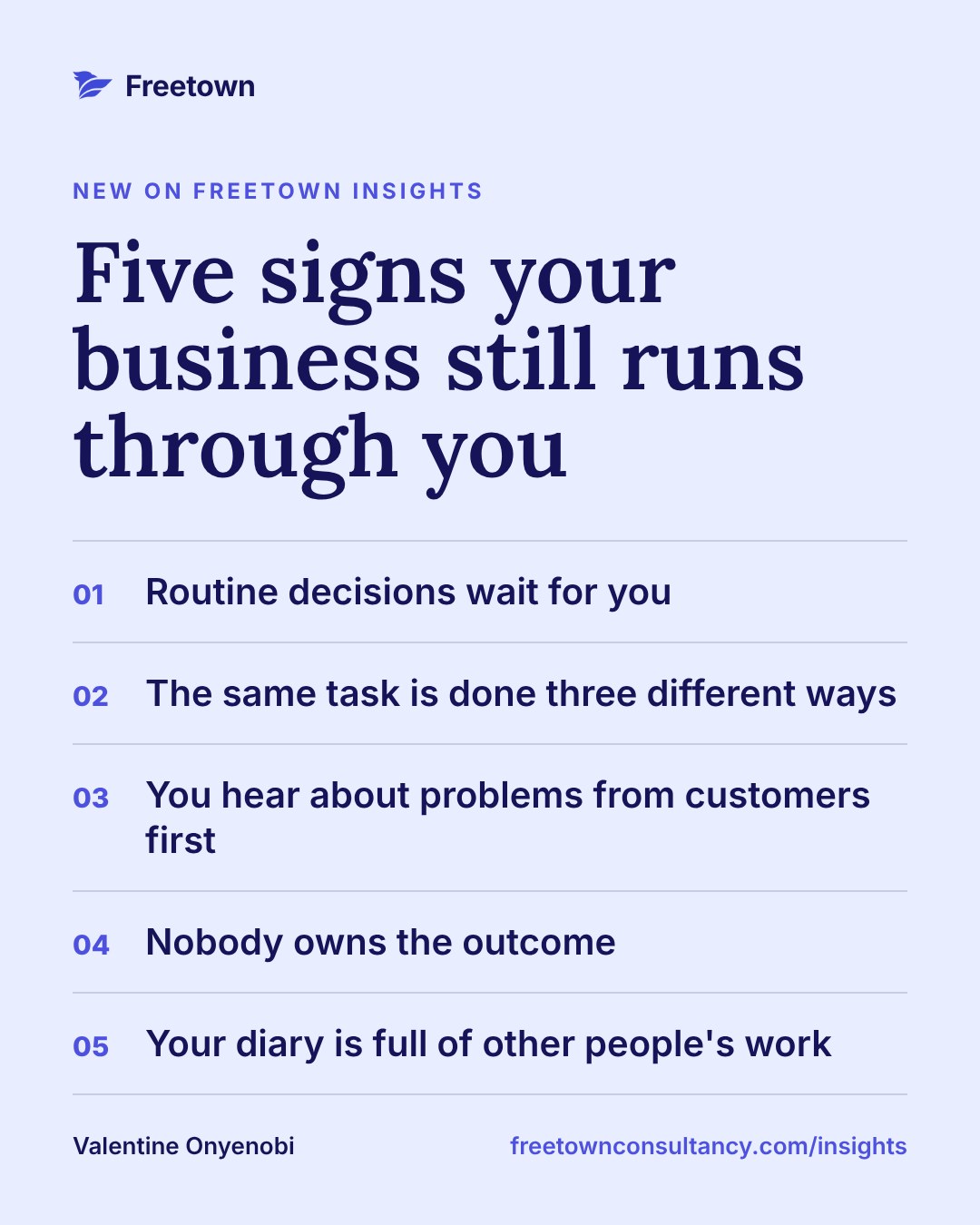
Most founders don't decide to become the bottleneck. It happens slowly.
In the early days, being involved in everything is how the business survives. You know every customer, every supplier and every problem. Then the business grows, the team grows, and the way it is run stays the same.
The signs are rarely dramatic. They show up as small delays, repeated conversations and a diary that never seems to be your own.
Here are five worth checking.
1. Routine decisions wait for you
- A discount for a regular customer.
- A supplier asking to move a delivery.
- A small refund.
None of these should need the founder. In many growing businesses they do, because nobody has been told where their authority starts and where it stops.
Every decision that waits for you slows down a customer, a supplier or a colleague.
What to fix first: list the ten decisions you make most often. For each one, decide who else can make it and up to what limit, then tell them.
2. The same task is done three different ways
Ask three people how an order is processed and you get three answers.
Each one works, more or less. But results now depend on who is on shift, and mistakes are hard to trace because there is no agreed way of doing it.
What to fix first: choose the process that causes the most rework or complaints and write it down as a simple, step-by-step procedure. One page is enough to start.
3. You hear about problems from customers first
Many businesses track activity: calls made, orders packed, hours worked.
Far fewer track results: orders delivered on time, stock available when needed, complaints resolved.
If a customer has to tell you something went wrong, the business has no early warning system. It is running on memory and goodwill.
What to fix first: choose five to eight numbers that show whether the business is healthy. Review them at the same time every week.
4. Nobody owns the outcome
When several people touch a process, problems fall between them.
The order was taken correctly. The stock was there. The driver turned up. The customer still didn't get what they ordered.
Everyone did their part. Nobody owned the result.
What to fix first: give every important process one named owner, accountable for the outcome, not just their step.
5. Your diary is full of other people's work
Look back at last week.
How much of your time went on work only you can do: strategy, key relationships, the decisions that shape the business?
How much went on answering questions, checking work, fixing handovers and finishing tasks someone else started?
When most of a founder's week is spent keeping the business moving, there is little left for moving it forward.
What to fix first: for one week, note every interruption and where it came from. The pattern usually points straight to the first system worth building.
Where to start
The answer is rarely to work harder, and rarely just to hire.
More people on top of informal systems usually means more questions, not fewer.
What helps is building the structure the business has outgrown:
- Clear decision rights.
- Documented processes.
- A handful of meaningful numbers.
- Named owners.
You don't need to fix everything at once. Start with the sign that costs you the most time, fix it properly, then move to the next.
If you're not sure which one that is, a Business Health Check is designed to find it: a focused review of one area of your business, with your top three fixes, in five days.
Valentine Onyenobi
Founder
Chartered Manager (CMgr MCMI), MBA, Certified ScrumMaster. Valentine provides senior oversight on every Freetown engagement.