Decisions Follow Information
Why delegation often fails before anyone delegates.
Published 14 October 2026 · 3 min read
When a growing business becomes too dependent on its founder, the diagnosis usually comes quickly.
- The founder will not let go.
- The founder needs to delegate.
- The founder needs better people.
But many founders have already tried to let go.
- They hired a manager.
- They assigned responsibilities.
- They told the team to make decisions without asking.
And a few weeks later, the questions came back.
The question behind the question
Watch what happens when someone in a growing business brings a decision to the founder.
A sales lead asks whether a customer can have another week to pay.
On the surface, it is a question about permission.
Underneath, it is a question about information.
- Has this customer paid late before?
- How much do they owe across all their orders?
- How much stock is committed to them this month?
- What was agreed the last time this came up?
The founder can answer in ten seconds. Not because they are the only person capable of judgement, but because they are the only one who can see all four answers at once.
The sales lead could make the decision.
They just cannot see enough to make it safely.
So they ask.
Where the information lives
In many young businesses, important information does not live in a system.
It lives in a person.
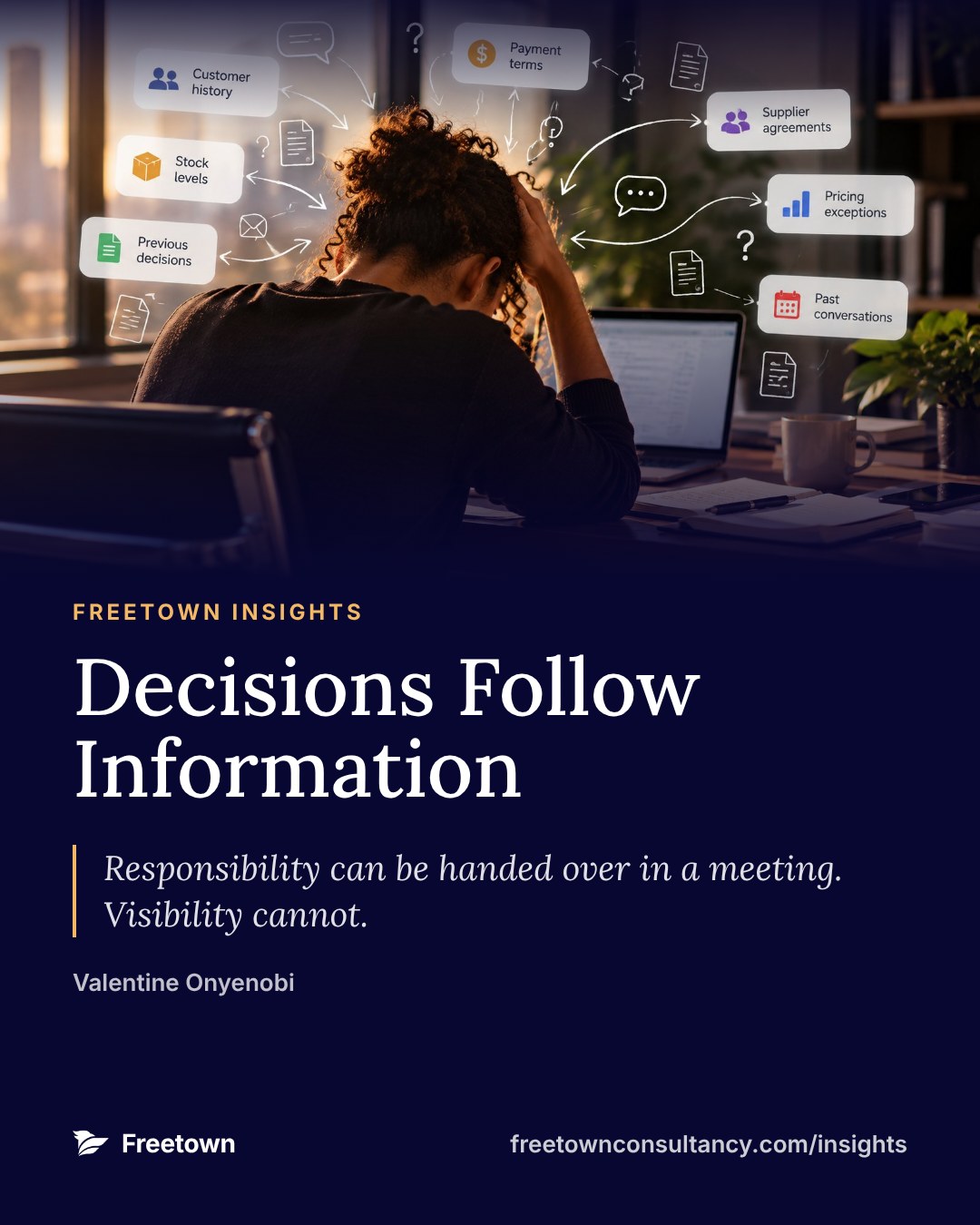
- Customer history lives in the founder's memory.
- Supplier terms live in a WhatsApp thread.
- Pricing exceptions live in conversations that were never recorded.
- The reasons behind previous decisions may not exist anywhere outside the people who made them.
In the early days, this works. Information and decisions sit in the same place. Nothing needs to travel.
Growth changes that.
More people now need to act on information that one person holds. Each decision that depends on that information requires a return to its source.
The founder becomes the point through which decisions must pass, not necessarily because they refuse to delegate, but because they hold the clearest picture of the business.
Why hiring rarely fixes it
A capable new manager can arrive with experience, sound judgement and a willingness to take responsibility.
What they may lack is visibility.
- They cannot see the full customer history.
- They do not know which supplier agreements were made informally.
- They cannot distinguish an established exception from a precedent that should never have been set.
So they ask.
The founder now answers questions from the team and from the person hired to answer the team's questions.
The business has added capacity on paper and another layer of dependence in practice.
The problem is not necessarily a shortage of people willing to decide. It is that the people expected to make decisions do not have the information needed to make them confidently.
What responsibility requires
Decisions follow information.
Wherever the clearest picture of the business sits, decisions will tend to travel there, regardless of what the organisation chart says.
Responsibility can be handed over in a meeting. Visibility cannot.
It must be built into how the business operates. Information needs to be:
- Recorded, so others can find it.
- Structured, so they can understand it.
- Maintained, so they can rely on it.
When this happens, people can make decisions without repeatedly returning to the person who first held the information. The founder remains involved where their judgement matters, rather than where their memory is the only available source of context.
Without it, an instruction to just make the call asks someone to decide with less information than the founder would accept for themselves.
Most people, sensibly, will ask first.
The question worth asking
It is easy to measure how many decisions a founder makes in a week.
It is harder to recognise how many of those decisions began as requests for information that nobody else could access.
So perhaps the more useful question is not who in your business is allowed to decide.
It is this:
If you stepped away for a month, what would your team no longer be able to see?
Valentine Onyenobi
Founder
Chartered Manager (CMgr MCMI), MBA, Certified ScrumMaster. Valentine provides senior oversight on every Freetown engagement.